Thursday, November 13, 2008

What the heck is a pedestal?

Being an Office Furniture Geek, I often slip into "furniture-ese", that obscure lingua franca of my fellow furniture shleppers. One of the primary terms in this language is the term pedestal.

Pedestals, BBF on the left and FF on the right.

A pedestal is a small set of file drawers that sits under a desk, or in a cubicle it sits under the work surface. Normally about 15 inches wide and 28 inches or less tall, they typically come in two varieties. Box/Box/File (BBF) or File/File (FF). A BBF is a 3 drawer pedestal that has two 6 inch tall (or box) drawers and one twelve inch tall (or file) drawer. A FF pedestal has two file drawers that are 12" tall.

Box drawers store your pencils, calculator and other small items. My Mom used to call this the junk drawer. The uncharacteristically clearly-named file drawer is for filing.

Just to confuse the issue, some people call a Box/Box/File a 6/6/12 and a File/File a 12/12. There are also B/F files with just two drawers of 6 and 12 inches, respectively. These tend to hang from the worksurface which makes them a suspended pedestal. Suspended meaning it is attached to the worksurface and does not touch the floor. Also there are mobile pedestals, which have wheels. And freestanding pedestals that are not attached to the worksurface above them. Some pedestals can have a pad on top and double as a guest chair in a pinch.

Below is a photo of what most people think is a pedestal.

Wednesday, November 12, 2008

Open versus Collaborative Environments


Whenever I am planning spaces for customers the issue of privacy versus openness comes up. Do we want our people to collaborate in an open environment? Or do we want more privacy so people can concentrate and do their work?

This often comes up as an issue of tall panels versus short. But it also incorporates, cubicle size, station orientation (Do I sit with my back to the opening or facing the opening?), who gets private offices and common areas like conference rooms, "all-hands areas" and informal "bean bag" areas.

Mark Erickson from Mark Erickson and Associates says it involves hi-tech versus hi-touch. "People often think they are communicating, when they are really only talking through their computers. The contact with other people is often missing."

With Mark's help, we came up with three phrases, probably not original, that describe the scenarios we see most often.

CAVE - where private offices and/or large cubicles, 8x8 or larger, with tall walls of at least 66 inches in height are used. Conference rooms are available for meetings as well.

CAVE and COMMONS - with tall cubes or mixed-height cubes where open areas are liberally interspersed throughout the space. These can be both formal conference rooms and informal areas for ad-hoc meetings.

OPEN COLLABORATIVE - with typically smaller cubes with height of less that 53" so that you can see throughout the space when standing. These may also include areas just loaded with tables. Open Collaborative spaces often have lot's of conference rooms for private meetings as well. (Above; Photo of Teknion workstation at Zazzle.)

I will be profiling different users in future blogs to point out the plusses and minuses of each design. Stay tuned.

SRK

Monday, October 20, 2008

Remanufactured Furniture

A Wall Street Journal Article titled "In With The Old", details the process of reconstruction as a green solution to both customers and producers. Furniture is featured prominently in the article.

The article describes three main processes that are encompassed by the term reconstruction: recycling, refurbishing and remanufacturing.

Recycling is breaking down products into their various components and then reconstituting them into another or similar product.

Refurbishing takes an existing product and restores it to its original condition.

Remanufacturing is like refurbishing but it aims to make the product better than the original. In the case of cubicles for instance it may add updated fabrics, finishes or features not in the original.

This process is very common the cubicle world. My experience is that the customer would save 25 to 40 percent over similar new product.

SRK

Monday, October 13, 2008

Fight Terrorism While Buying Cubicles


The U.S. is under severe pressure to reduce its dependence on foreign oil. This isn't just to keep prices down at the pump. It directly affects world politics with regard to the support of terrorism by Islamic Fundamentalists like Al Qaeda and the Taliban. Every time we buy oil from the Saudi's, we are shipping money to them. They in turn fund these groups by financing Islamic fundamentalist madrassas (schools) in Pakistan and Afghanistan. Many of these schools are where young people are taught the fundamentalist teachings which later make them more likely to join these terrorist organizations.

These ideas are outlined in great detail in the books Hot, Flat and Crowded by Thomas Friedman and Three Cups of Tea by Greg Mortenson and Oliver Relin.

As Americans, every purchase we make has an effect on the world. If you want to choke off the supply of money going to these organizations, the best thing you can do is buy items that use as little petroleum in their transport and manufacture as possible.

Most office furniture these days is manufactured off-shore, primarily in China. The manufacturing process alone is petroleum intensive. But the transportation of those items to the U.S., is also petroleum based.

By purchasing previously-used furniture locally, you can eliminate almost all of the petroleum consumption. Another option is to purchase locally refurbished product, eliminating the long-haul transportation and most manufacturing.

One new line of furniture, GQA Furniture, is produced from over ninety percent repurposed content. Cubicles are recovered with fabric made from recycled plastic bottles. Pedestals and all other metal are repainted using water-based environmentally sound painting practices. Worksurfaces are used surfaces that are turned upside-down and re-laminated. They are then edged with polypropylene edge banding. All the work is done locally to reduce transportation costs. Right now GQA is just being rolled out in Northern California, with plans to expand to the larger market soon.

Whoever thought you could be a Patriot while buying a cubicle?

SRK

Friday, August 22, 2008

LEED - Leadership in Energy and Environmental Design

LEED is a set of standards originally intended to promote the use of environmentally progressive and sustainable techniques in construction. As it applies to furniture, there is no clear standard at this time although it appears that several of the larger furniture manufacturers are doing their best to get specs written around their products.

In its pure form, LEED would have encouraged, the reuse and reworking of materials for the lowest possible impact on the resources of the planet. Of course it is very difficult for large manufacturers of building materials and furniture to produce what they are used to producing, when they are told not to produce it.

Instead, as I did a cursory examination of the specs as they evolved from one version to the next, I see more things getting LEED credits (More credits, higher score) for things like limiting off-gassing and 5% Resource Reuse. For instance, in LEED-NC Version 2.1, you get 1 point for 5% resource reuse and another for 10% resource reuse, but not a single point more for 100% resource reuse. So someone making a chair using 100% recycled materials would get the same credit for these items as someone making a chair with only the arms being from recycled content.

In the end, I suspect that one will have to have a high LEED score to be considered for large government and commercial projects. To get the high LEED score, one will have to submit their products to some certified provider who will charge an outrageous sum to provide the certification. Then the 10% recycled chair will have a LEED score, while a used chair from a local supplier will not. The small local supplier will not be able to afford the certification. So the 10% chair will win the bid and the used chair will go to the dump.

Probably not what LEED was originally intended to do. With a few tweaks I think LEED could be a powerful force in reducing our countries dependence on foreign oil while helping green the planet. By encouraging the re-use of materials more local labor will be employed, keeping U.S. dollars at home. The impact on our environment in both the reduction of waste and off-gassing could be substantial. Hopefully LEED will be reworked to give even more points for higher percentages of re-used content.

SRK

Thursday, August 21, 2008

Laminate or Wood - What's the difference?

Desks are usually made out of wood or laminate. Generally wood is more expensive, but not always. What's the difference between wood and laminate?

To start with almost all office furniture these days is made from a thin top surface applied on a substrate of fiberboard or particle board. In other words, your wood desk isn't made from a solid piece of wood or a few boards pieced together. It probably has a piece of particle board with a very thin sheet of wood veneer or plastic laminate. There are countless grades of particle board, veneers and laminates with detailed differences which I will not go into here, but might in a future blog.
After this sheet of particle board with a surface of veneer or laminate is put together, it is banded around the edge with another piece of wood or some type of plastic edge. These pieces are then put together to make a desk.

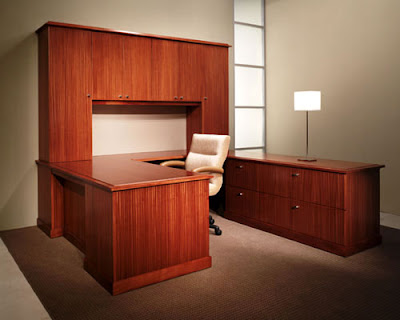
Wood veneer is actual wood. (See photo of DFm wood desk above.) It is sliced in very thin sheets, often somewhere between 1/16 and 1/8 inch thick. Almost any wood species can be used. Most popular in the U.S. are cherry, mahogany, walnut and maple. Usually a matching edge of wood is put on the edge of the top. More expensive desks use thick pieces of this wood edge banding, making for a very durable edge. The whole thing can be stained and finished just like a solid piece of wood. It is also as sensitive to damage as any other piece of wood.

Laminate is made of resin, paper and plastic. The paper can have a multitude of patterns, including wood patterns. The resulting laminate surface is applied to the fiberboard in a similar fashion to veneer. The edge is usually a PVC, plastic or polypropylene strip glued to the particle board. Laminate tops are generally more durable than wood. Resisting water, heat and impact better depending on the quality of the laminate. Also, you can get a very consistent look with laminate from one desk to the next. Where-as wood can very, expecially if a new piece is ordered after a long period of time. (Photo of laminate desk below.)

There is a less expensive product often referred to as melamine that is cheaper and less durable than laminate. It is difficult to see the difference at fist look.

So which is better? It depends what you want. If you want a unique finish, warm touch or opulent look, veneer usually does that better. If you want a durable, consistent less expensive piece, you might consider laminate.

Just to confuse the issue, you can also have a laminate top with a wood edge.

Thursday, August 14, 2008

Filing Proficiently Saves Money and Space


Sometimes it amazes me how much air people file in their file cabinets. Why would someone want to pay good money for a file cabinet and then have it take up valuable floor space and not fill it up? I guess they just want to keep furniture dealers like me in business by buying more files.

A classic example is a 36 inch wide lateral file. If you are like most people and file letter-size hanging-files, you should never buy a 36 wide file cabinet. Let me explain.

A lateral file is a file cabinet that is wider side-to-side than it is deep front-to-back. (See photo at right.) Typically 18 to 20 inches. They come in three widths, 30, 36 and 42. The most efficient way to file in lateral file is front-to-back, rather than side-to-side.

A hanging letter-sized folder is typically 13" wide. The dimensions of a file drawer will be typically 16" deep on a 18"deep lateral file. The width of the drawer will be 39" on a 42" wide lateral file and 33" on a 36" wide lateral file.

To measure how much filing fits in a drawer is easy. In a 36" wide file you get 33" of filing side-to-side. Since a hanging file is 13" deep, side-to-side filing results in the back 3" of the drawer empty, filing air. If you hang your files front-to-back you get two rows 16" deep or 32" of filing. But the middle 6" of the drawer file air.

A 30" wide lateral file drawer would have also 32" of front-to-back filing for less cost and floor-space than the 36". It files no air in the middle.

A 42" wide lateral file is the big winner though. Side-to-side filing gets you 39" per drawer, although you still file some air in the back. But front-to-back you can fit three rows of 16" for 48" total. 50% more filing than the 36" file for only 17 percent more floor space taken up and now air filed.

Conclusion, spend a little more and get a 42" wide lateral file with front-to-back filing. Make sure you get at least 4 drawer high as well, as long as you don't need to put it under a desk top (2 drawer) or want to have a standing height counter on the top (3 drawer).

Filing Chart Per 18" deep drawer
STS - Side-to-side
FTB - Front-to-back

30W - 27" STS, 32" FTB
36W - 33" STS, 32" FTB
42W - 39" STS, 48" FTB

Shown at right is a 42W lateral file drawer with front-to-back filing.

Scott R. Kline
Smart Interiors, Inc.